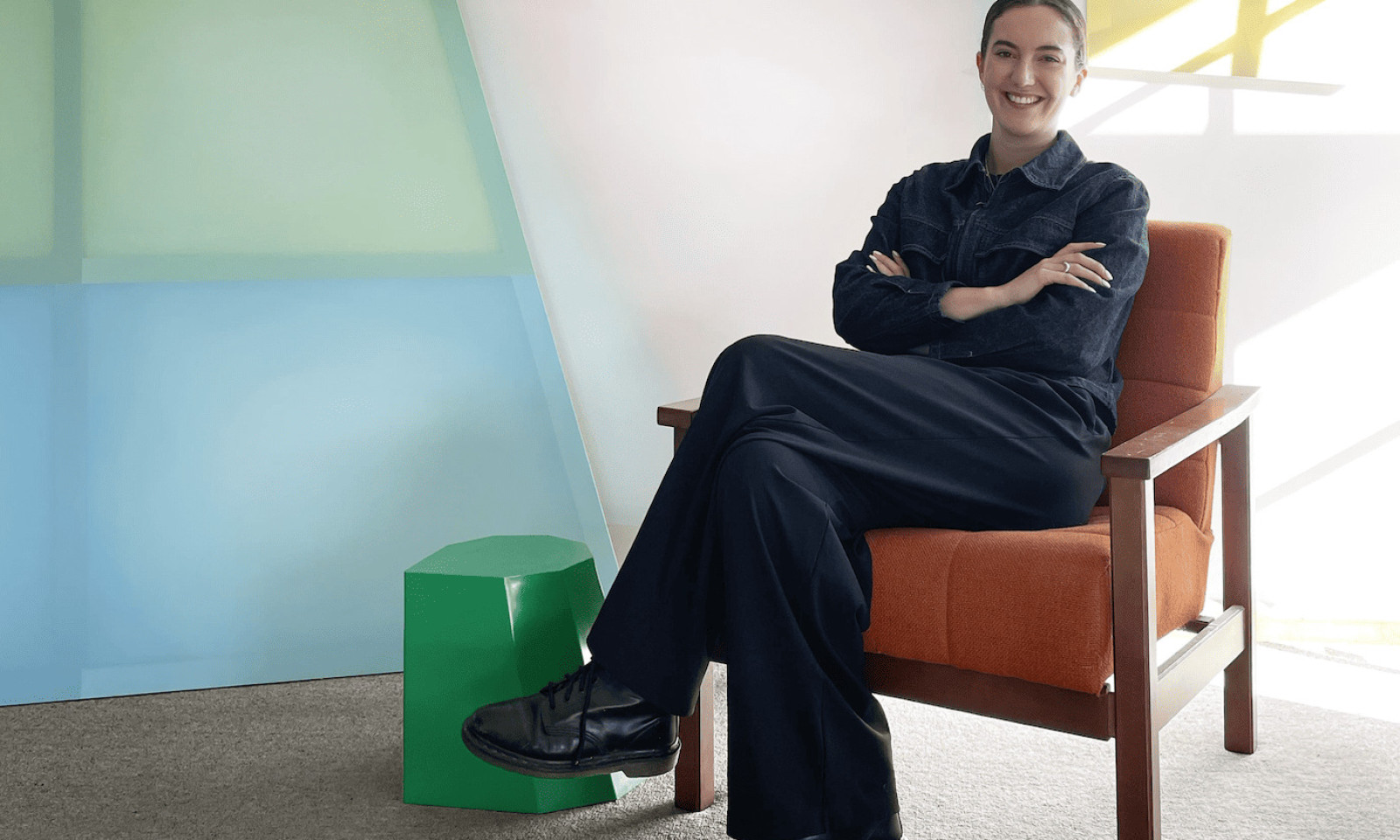
The upcoming exhibition at McLeavey is titled To a Shadow’s Edge. Talk me through the process of making the beautiful works of art that make up this collection. The gallery has such a beautiful stained glass window and natural light. Did you have this in mind while creating these pieces?
Presenting my work in such a unique and historically rich space, I knew I wanted make some of the works in the exhibition site responsive.
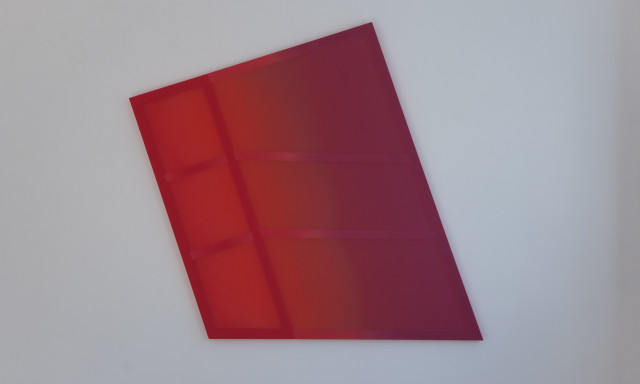
I spent time considering the gallery through images: the windows, the stairs, and the distinctive architectural features. With a sensitivity to the fleeting geometries of light and shadow within the gallery, I knew I wanted the work to engage directly with the architecture and the nature in which light falls, and the quiet impression these shadows leave behind. Colour was introduced with careful consideration, layering tones to explore colour theory, optical effects, and the illusion of movement, mirroring the shifting presence of light in the space.
Instead of working on a traditional canvas, I stretch opaque textiles, primarily silk, chiffon, and georgette over my designed and constructed frames. These surfaces act as veils or muting agents. The textiles retain their solid colours while the true composition lies beneath. Painted backing boards and the stretcher bars become central to what the viewer perceives. The image does not sit on the surface, it is filtered through it, inviting the viewer to look through and beyond. My frames respond intimately to each site they inhabit, absorbing the unique language of their surroundings. Light doesn’t just illuminate, it engages, its daily conversation with the hues brings the work to life, emanating new moods as time shifts.
You studied at Toi Rauwhārangi – College of Creative Arts Massey University, how did your time in Wellington shape your practice?
During my time studying in Wellington my practice developed significantly. In the early years, I was focused on mark-making and abstract expressionist painting. A major turning point came during a university arts trip to New York in 2016, in the middle of my third year. That experience hugely expanded the way I thought about painting - encouraging me to think beyond its traditional boundaries.
Living in Te Aro for four years, I often found my works referencing the urban inner city colours, at the time working in mostly earth tones to reflect directly outside my flats or in pinks and oranges, referencing roadworks experienced while walking to Uni.
Having such a high concentration of central galleries, institutions, and creative spaces on my doorstep really enriched the development of my early art practice, being able to engage with and draw inspiration from a vibrant and experimental art scene that champions a diverse range of voices.
Talk to me about your place as a New Zealand artist and how our landscape and architecture has impacted you.
After spending an extended period of time in Europe last year, I returned with a renewed appreciation for our rich landscapes in Aotearoa - no longer taking for granted its scenery that I might have previously overlooked, a feeling many others share. Our light here feels unique, with our strong UV and hard flat light that has such a clear quality to it.
I am based in Ōtautahi with mountains, sea and lakes at our back door step, all of which are constant reminders of the beauty of colour in our natural environments. Otautahi being the garden city it is, showcases even more distinct seasonal colour changes, particularly cherry blossoms and daffodils in spring to the vibrant hues of autumn leaves.
There is an ever changing architecture across our city post earthquake which means I am often finding juxtaposing moments of heritage and modern. I often take photos of interesting windows or lines.
As someone who has a full text exchange with a friend purely of photos of shadows on walls, I love how your work explores shadows and changing light. Can you tell me a little about what started you on this journey of exploration? How does natural light influence your process of how you think about place in your work?
When I first began stretching opaque textiles over frames during my honours year, I became intrigued by how the crossbars beneath the surface became visible and unintentionally became part of the composition. Over time, I started to draw connections between the geometry of my stretcher frames and the intersecting lines of window panes. This observation marked the beginning of my exploration into site-specificity. I began replicating the exact shapes of windows from the sites I was working in, and incorporating the colours seen directly outside them.
While my work had always been in quiet conversation with light, allowing it to pass through and beyond the surface of the textiles, it wasn’t until around six years ago that I began similarly documenting light and shadow moments that caught my eye. My ideas developed to more deliberately imitate the lines and forms that we cast across floors and walls. I started introducing perspective skewed forms and shifted from monochromatic palettes to compositions with multiple colours, investigating how subtle variations in hue could affect spatial perception and create a sense of dimensional tension.
I’m particularly drawn to fleeting optical effects, light refraction, falloff, bounced light, and subsurface scattering, especially as they interact with coloured surfaces, subtly altering the way we perceive hue. When installing work, understanding the placement and how the light shifts on a wall throughout the day is useful in allowing the work to continually change. In these quiet transitions, the reading of colour and form is never fixed, but always evolving.
Finally, where do you think the best spot in Wellington is to sit and watch the changing light?
Wellington being such a unique, compact, and walkable city it is easy to experience a variety of light conditions within a short distance. The best spot to watch the changing light isn’t just one fixed place, it’s often found in the quiet, in-between moments the city offers.